

Given the speed at which AI models are progressing, we need to project ourselves into a marketing organisation where their applications operate at scale.
Take that projection to its logical limit: everything that can reasonably be automated has been automated.
Consumer insight is at our fingertips, connected to the question we are trying to answer.
Strategy and planning scenarios are available on demand.
Digital execution, from content creation to media activation, runs automatically against agreed objectives.
Sales and pricing are continuously optimised within commercial and brand constraints.
Performance measurement is embedded throughout the work and feeds the next round of decisions.
So what becomes the constraint?
Consider a brand team deciding whether to enter a new category. Consumer Insights sees an unmet need. Finance questions the return. Sales wants investment behind the existing portfolio. A local market doubts that the global proposition will work in its market.
AI can give each of them better evidence. It can model different scenarios, challenge assumptions and quantify consequences.
But it cannot, through better analysis alone, determine whose priority should prevail, how much uncertainty the organisation is prepared to accept or who is willing to commit the resources.
This is the question I keep coming back to as we build systems that increasingly accelerate research, analysis and recommendation:
A company may become much faster at producing a case for action without becoming faster at agreeing which action to take.
That may become one of the defining management problems of AI-enabled marketing.
The difficulty is not new. In a McKinsey survey published in 2019, 61% of respondents said most of their decision-making time was used ineffectively. Only 37% said their organisations made decisions both quickly and well. The survey predates generative AI. It describes the organisational problem AI is now inheriting. [1]
A recommendation is not a decision
Decision science gives us a useful distinction. Baruch Fischhoff and Stephen Broomell separate judgment, preference and choice. Judgment concerns what we expect to happen. Preference concerns how much we value the possible outcomes. Choice combines the two. [2]
That distinction matters enormously for marketing.
Two executives can agree on exactly the same demand forecast and still disagree about launching a product. One may prioritise contribution over the next twelve months. The other may value establishing a position in a category that could take several years to develop.
More accurate forecasting can narrow their disagreement about what is likely to happen. It cannot necessarily resolve their disagreement about what the company should pursue.
Corporate decisions also distribute those judgments and preferences across many people. Consumer Insights, Finance, Sales, Marketing and local markets possess different information, carry different responsibilities and often have different incentives. Research on the social context of decision-making has long shown that group decisions cannot simply be understood as individual reasoning multiplied across several participants. [3]
This is why a recommendation can be analytically convincing and still fail to become an effective decision.
A decision eventually requires an organisation to do something quite different from producing an answer: commit resources to a course of action despite uncertainty.
Most of the decision happens before final approval
This becomes particularly important with AI because final approval is only the visible end of a much longer process.
By the time a leader receives a recommendation, several consequential choices may already have been made: how the problem was framed, what counted as success, which evidence was considered and which alternatives entered the comparison.
The final decision is therefore partly shaped by a series of choices before the choice.
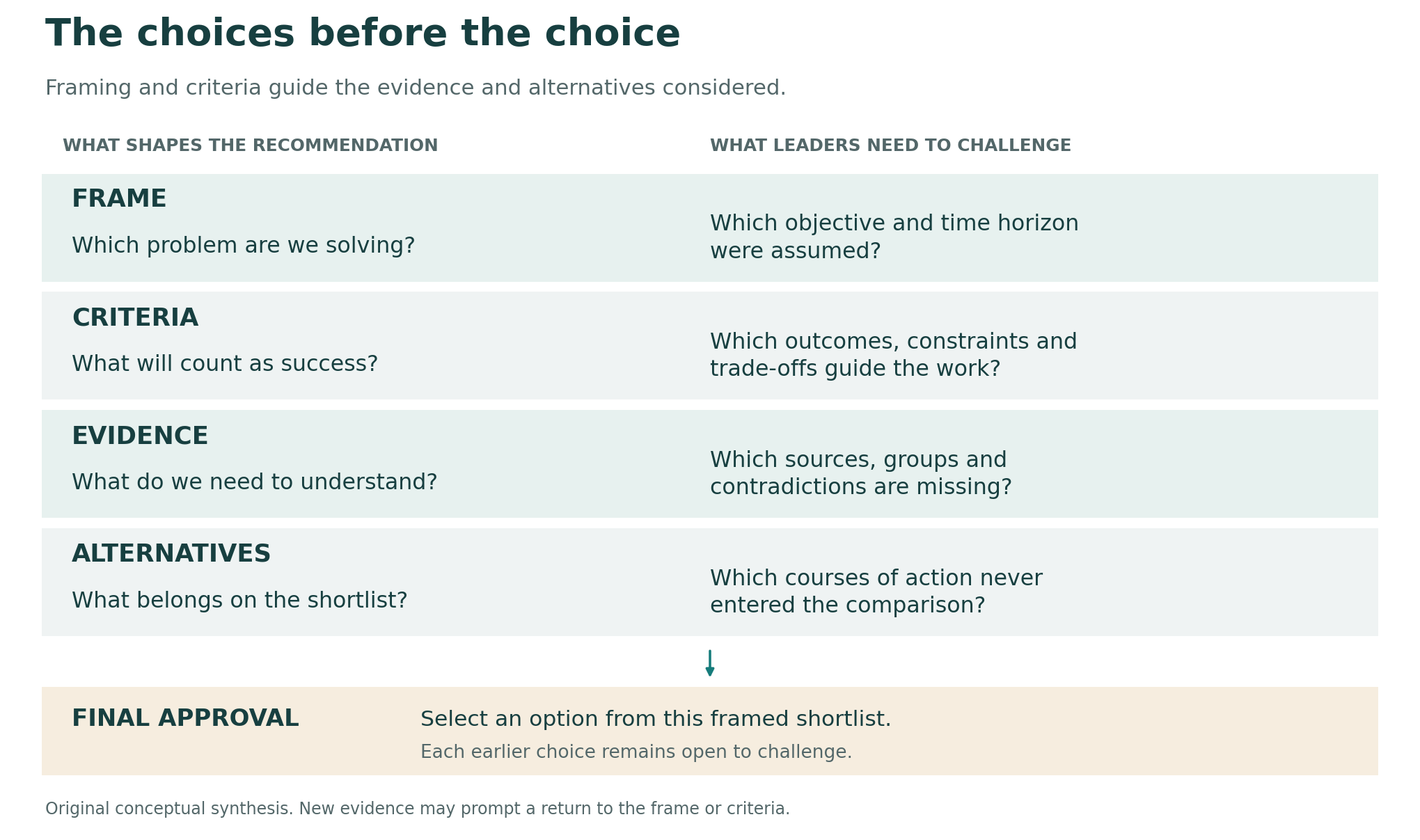
Figure 1. The choices before the choice. Framing and criteria guide the evidence and alternatives considered; each earlier choice remains open to challenge.
Imagine a skincare brand trying to grow. If the question is framed as “How do we maximise revenue next quarter?”, promotion and distribution may dominate the analysis. If the question becomes “How do we establish credibility in a new skin concern over the next three years?”, R&D, product development and professional recommendation may become much more attractive.
The underlying data has not necessarily changed. The decision has.
This is where AI starts to influence the decision well before anyone clicks approve.
A system may inherit the frame from a brief, retrieve evidence from a selected set of sources, generate alternatives against configured constraints and rank them according to a chosen objective.
It can also do the opposite: expose assumptions, compare different time horizons, identify missing evidence or demonstrate how the recommendation changes when a constraint changes.
The objective should not simply be to make the final AI recommendation explainable. The choices that produced the recommendation need to be inspectable too.
This challenges one of the most common responses to concerns about AI decision-making: “A human will make the final decision.”
That may not be sufficient. If AI has helped determine the frame, select the evidence, generate the alternatives and rank them, a great deal of the decision has already been shaped before the human reaches the approval screen.
What does the evidence actually tell us?
There is already meaningful evidence that AI can improve the work feeding decisions. In a preregistered experiment involving 791 professionals at Procter & Gamble, participants worked on product-innovation challenges individually or in pairs, with or without generative AI. Individuals using AI produced proposals assessed at a similar quality to teams working without AI. AI also helped participants produce solutions integrating technical and commercial perspectives. [4]
That is significant. It suggests that AI can improve both productivity and the ability to combine knowledge that previously required different people or disciplines.
But the experiment assessed the quality of proposals. It did not test whether organisations subsequently made better investment decisions, resolved competing priorities more effectively or executed those recommendations successfully. That distinction matters.
A second body of evidence challenges another comforting assumption: simply adding human oversight does not automatically produce the best result. A 2024 meta-analysis covering 106 experiments found that human-AI combinations outperformed humans working alone on average, but underperformed whichever of the human or AI was stronger when considered separately. Decision tasks showed losses against that stronger benchmark. [5]
The studies were conducted before the latest generation of models, so this should not be read as a ranking of today’s AI systems. The more important finding is organisational:
“Human + AI” is not, by itself, a design principle. The way responsibility is divided matters.
There is another complication. Experiments by Glickman and Sharot found that AI input could influence people’s subsequent judgments: biased AI could shift them, while accurate AI could improve them. Their experiments were not corporate marketing decisions, so the result should not be overgeneralised. But they challenge the idea that a person remains independent of a system merely because they retain final approval. [6]
Together these findings point toward a different question. Not simply: should a human remain in the loop? But: what role should AI and people each play across the whole decision process?
AI does not remove three organisational problems
More powerful AI can improve evidence, generate alternatives and model consequences. Three problems remain fundamentally organisational.
Conflicting objectives
A brand may want to recruit new consumers while Sales wants to maximise this quarter’s contribution. AI can model the consequences of allocating the budget differently. It cannot determine which compromise leadership should accept unless the organisation has already encoded that preference into its objective. And that simply moves the decision upstream.
Decision rights
Many people may legitimately contribute to a strategic marketing decision. Far fewer should have the right to stop it indefinitely. Existing approaches such as Bain’s RAPID remain relevant because they distinguish between recommending, providing input, agreeing where agreement is genuinely required, deciding and executing. [7]
AI does not remove those decision rights. Assigning an agent to produce the recommendation does not tell us who may change the objective, challenge the evidence or authorise the resulting action.
Commitment
Authority answers who can decide. It does not guarantee that the people expected to implement the decision understand it or will support it. That matters particularly when choices affect budgets, responsibilities or existing commitments.
The objective should not necessarily be unanimous agreement. It should be a decision that can survive informed challenge and still produce coordinated action.
So how much authority should AI have?
A single rule for an entire marketing organisation makes little sense. Generating an early innovation territory is not equivalent to approving a product claim. Optimising media within predefined boundaries is not equivalent to repositioning a core brand.
MIT CISR’s work on AI decision rights provides a useful starting distinction: consider both ambiguity and risk. [8]
For marketing, I would translate this into four broad situations.
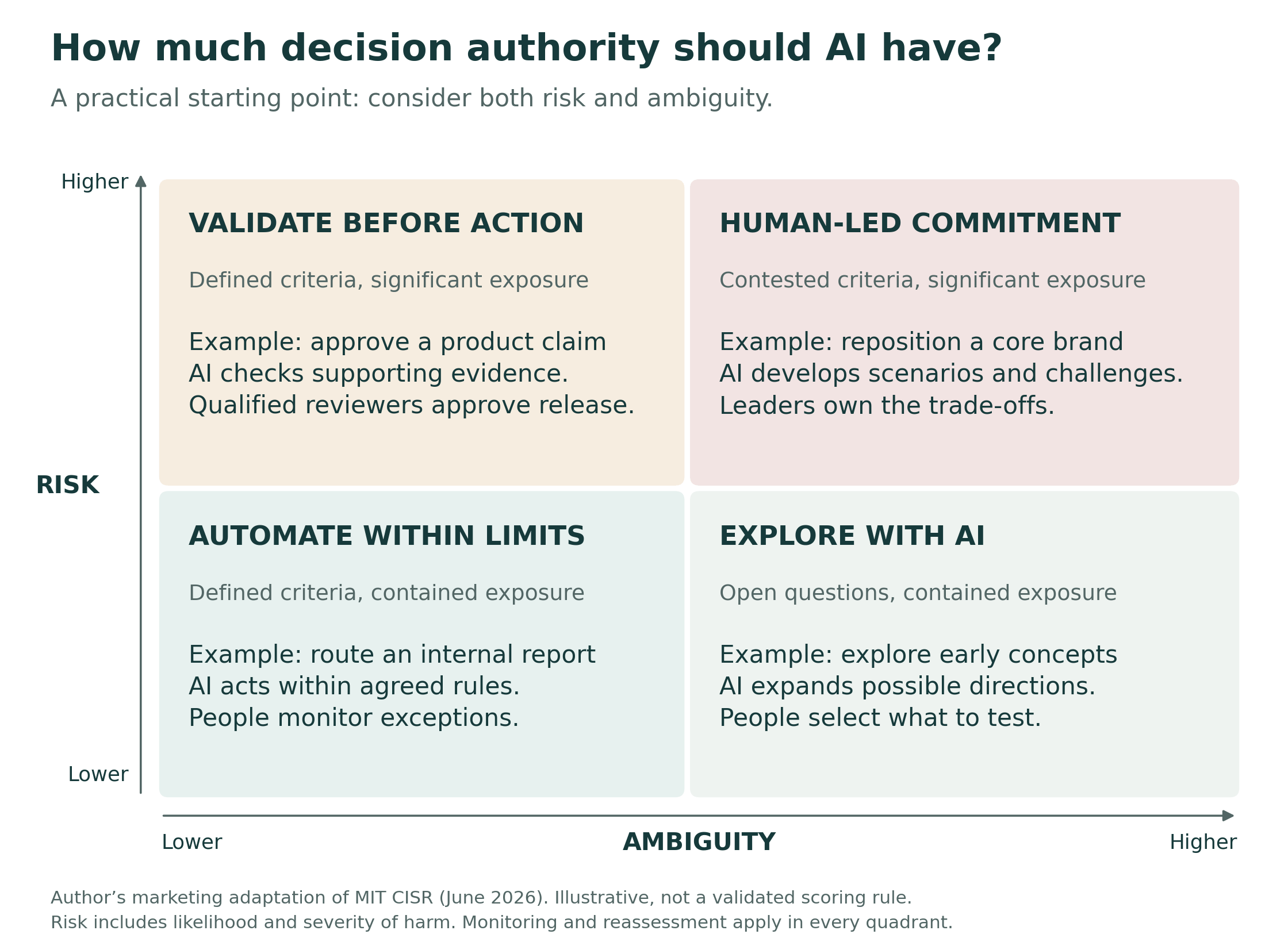
Figure 2. A practical starting point for allocating AI decision authority based on risk and ambiguity. Author’s marketing adaptation of MIT CISR (June 2026).
Low ambiguity + low risk — Automate within limits
The criteria are defined and the consequences of an error are contained. AI can act within agreed rules, while people monitor exceptions and performance.
High ambiguity + low risk — Explore with AI
The problem is still open, but the cost of exploration is limited. This is where AI can be particularly powerful: generating alternative hypotheses, concepts, positioning routes or scenarios that people may not have considered. The output remains provisional.
Low ambiguity + high risk — Validate before action
The requirements may be clear, but a mistake has significant consequences. AI can retrieve evidence, check consistency or flag issues, while qualified people retain approval before the action is released.
High ambiguity + high risk — Human-led commitment
Strategic decisions often sit here. The organisation may disagree about what success means, which trade-offs are acceptable and what existing assets it is willing to put at risk. AI can develop scenarios, challenge arguments and expose assumptions. Leadership owns the commitment.
The important point is that the same initiative can move through all four situations.
Exploring concepts for a new skincare proposition might sit in Explore with AI. Assessing the evidence supporting a product claim may sit in Validate before action. Optimising campaign spending after launch could increasingly sit in Automate within limits. Changing the positioning of the master brand may remain a Human-led commitment.
Giving AI permission to generate options therefore does not give it permission to publish them, allocate a budget behind them or change the strategic direction of the brand.
The useful question is not “Should AI make marketing decisions?” It is: “Which decision, at which stage, with what level of ambiguity and consequence?”
The leadership job is changing
If AI can take on more analysis, structure choices and execute within defined boundaries, the impact goes well beyond productivity. It changes how leadership, strategy, culture and organisation need to work together. The organisation has to become capable of making many more decisions without losing coherence, challenge or accountability.
1. Leadership → leverage
Today, leadership attention is a hard constraint: only so many decisions can reach senior people. AI changes that. By automating analysis, filtering exceptions and structuring choices, leaders can meaningfully steer many more decisions without becoming the bottleneck.
2. Strategy → codification and alignment
Strategy often remains implicit in how leaders frame problems and weigh competing options. AI forces more of that logic to become explicit: the frame, the criteria, the evidence to consider and the alternatives to compare. Once those are codified, decisions can be made consistently across the organisation — by people or by AI, depending on their ambiguity and consequence — without losing strategic alignment.
3. Culture → challenge and learning
When AI generates convincing recommendations instantly, culture must supply what the machine cannot: doubt, dissent and the honesty to change course. Leaders now have to build that deliberately — rewarding the person who breaks a flawed case as much as the one who built it, making uncertainty safe to voice, and treating fast correction as a strength rather than a failure.
4. Organisation & talent → ownership and orchestration
Today, layers of management help move information, coordinate work and escalate decisions. AI can absorb much of that coordination, enabling flatter organisations with wider spans and smaller teams owning outcomes end to end. That arithmetic makes talent density decisive: when five people do what twenty did, each person's judgment carries four times the consequence — top performers stop being an advantage and become the operating model. The manager's job shifts accordingly: from supervising activity to orchestrating human and AI capabilities and coaching judgment as deliberately as companies once trained technical skills.
As answers become cheaper, the ability to decide becomes more valuable.
How we are embedding these principles in Alphabrand
This is also shaping how we think about building Alphabrand.
Our objective is not to automate marketing decision-making. It is to build technology that makes people and organisations better equipped to make those decisions.
That leads us to a few principles:
Build Consumer Intelligence as the foundation. Bring together internal research, syndicated data, market signals and structured datasets so teams can work from a broader and more consistent evidence base.
Turn data into decision-ready intelligence. Combine document intelligence, NL2SQL and external data collection so marketers can move from a business question to evidence, analysis and implications without stitching together multiple tools.
Structure the marketing decision workflow. Build around the actual sequence of work — framing the question, defining criteria, finding evidence, exploring alternatives and comparing options — rather than around a standalone chat response.
Codify company context and decision criteria. Capture business definitions, strategic constraints, brand rules and dataset logic so outputs reflect how the organisation actually thinks and remain consistent across teams and projects.
Keep the reasoning traceable. Sources, calculations, assumptions and the path from evidence to recommendation should remain inspectable, particularly when AI is influencing consequential choices.
Design for collective decisions. Important brand decisions involve CI, Marketing, R&D, Finance, Sales and markets. The system should create a shared basis for discussion rather than another individual copilot.
Sources
[1] McKinsey. Decision making in the age of urgency. Published April 2019; survey conducted February 2018. Read source
[2] Fischhoff, B., and Broomell, S. B. Judgment and Decision Making. Annual Review of Psychology, 2020. Read source
[3] Larrick, R. P. The Social Context of Decisions. Annual Review of Organizational Psychology and Organizational Behavior, 2016. Read source
[4] Dell’Acqua, F., et al. The Cybernetic Teammate: A Field Experiment on Generative AI and Teamwork. Organization Science; published online June 12, 2026. Read source
[5] Vaccaro, M., Almaatouq, A., and Malone, T. When combinations of humans and AI are useful: A systematic review and meta-analysis. Nature Human Behaviour, 2024. Read source
[6] Glickman, M., and Sharot, T. How human–AI feedback loops alter human perceptual, emotional and social judgements. Nature Human Behaviour, 2025; published online December 18, 2024. Read source
[7] Bain & Company. RAPID Decision Making. October 13, 2023. Read source
[8] Sebastian, I. M., Weill, P., Haskamp, T., and vom Brocke, J. Designing Decision Rights for AI. MIT CISR, June 18, 2026. Read source