
Let’s retire a myth. The image of Cannes Lions as one long rosé-soaked lunch belongs to a festival that no longer exists, the one before run-clubs, cold plunges and 8 am breakfast meetings.
I’m local, I spent many years in wines & spirits, and I’ll tell you the part that’s still true: the rosé is excellent, it’s from my doorstep, and one good glass at the right table still closes more than any panel. The trick isn’t drinking more. It’s drinking better.
So — half local pride, half public service — a proper guide to Provence rosé: the appellations and how they differ, the grapes behind the pink, how to actually serve it, and the leading estates worth knowing. With, yes, a personal shortlist matched to the exact Cannes moments they were born for. Some of it is serious advice. Some is just fun. And to drink with Moderation!
And if you want to talk rosé — but also marketing, creativity, and where our industry is actually heading — ping me. I’m in Cannes to introduce alphabrand.ai, and there’s no better way to do it than with a glass in hand. Though, full honesty: mine might be a Ricard.
The lay of the land
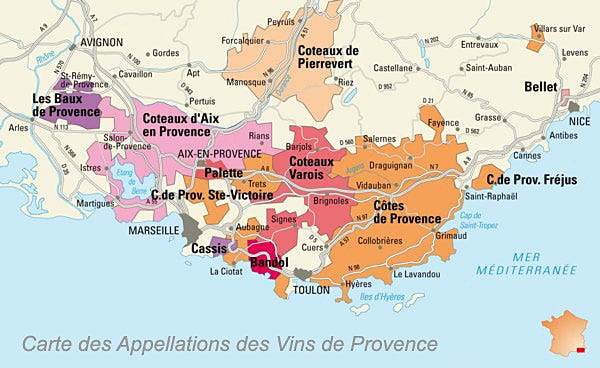
Provence makes more pink wine than anywhere on earth, and not all of it is the same pink wine. Four big names cover nearly everything you’ll be handed this week — plus one small gem worth hunting down. Learn them and you can nod knowingly at any rooftop.
Côtes de Provence — the default
Two of every three Provence rosés. Pale as morning light, crisp, grapefruit and white peach, stretching from Saint-Tropez to the hills behind Toulon. If a glass appears in your hand and nobody can name it, it’s this. Worth knowing its coastal sub-zones — La Londe, where Sainte Marguerite sits, and Sainte-Victoire, under Cézanne’s mountain.
Principal grapes: Grenache, Cinsault, Syrah, Rolle (Vermentino).
Leading wines: Château d’Esclans — Garrus · Domaine Ott — Château de Selle · Clos Cibonne — Cuvée Tradition Tibouren · Château Sainte Marguerite — Cru Classé · Château Minuty — Rosé et Or · Whispering Angel — Caves d’Esclans.
Coteaux d’Aix-en-Provence — the value
West toward Aix and the edge of the Rhône. Rounder, sunnier, more generous, and usually kinder on the invoice. Château Virant country — the appellation that doesn’t need to be seen at the right party to know it’s good.
Principal grapes: Grenache, Cinsault, Syrah, Counoise.
Leading wines: Château Vignelaure — La Source · Commanderie de la Bargemone · Château La Coste — Rosé.
Coteaux Varois en Provence — the curveball
The cool, high-altitude heart around Brignoles. Picked later, wound tighter, with more nervy acidity than anything down on the coast. The one a sommelier drops into conversation to see whether you’re actually paying attention.
Principal grapes: Grenache, Cinsault, Syrah, Mourvèdre.
Leading wines: Château La Calisse — Patricia Ortelli · Château de l’Escarelle — Les Deux Anges · Roseblood d’Estoublon.
Bandol — the serious one
Mourvèdre-driven, structured, deeper-hued, built to age — the rosé that behaves like a red. Domaines Ott’s Château Romassan lives here. Order it when you want the table to know you read past the front label.
Principal grapes: Mourvèdre (min 50%), Grenache, Cinsault.
Leading wines: Domaine Tempier — Bandol Rosé · Château de Pibarnon — Bandol Rosé · Domaine de Terrebrune — Bandol Rosé.
Cassis — the local gem
A tiny amphitheatre of vineyards above the calanques east of Marseille — celebrated for its whites, but its rosés are saline, taut and quietly serious. Made in small quantities, rarely on a Croisette wine list. Order it and you’ve signalled you actually know Provence, not just the rooftop circuit. Best drunk looking at the sea, not at a step-and-repeat.
Principal grapes: Grenache, Cinsault, Mourvèdre, Carignan.
Leading wines: Clos Sainte Magdeleine — Cassis Rosé · Domaine du Paternel — Cassis Rosé · Bontoux-Bodin — Cassis Rosé.
↳ No, there is no Saint-Tropez AOC — the town sits inside Côtes de Provence, under its own named terroir, Golfe de Saint-Tropez. And two appellations almost nobody pours on the Croisette — Bellet, in the hills above Nice, and Palette, near Aix — are worth a detour if you somehow find a free afternoon. You won’t.
Provence Rosé 101 — the bit nobody explains
It isn’t red wine, watered down. Provence rosé is pressed from red grapes that meet their skins for just a few hours. That brief contact is where the whisper of colour — and all the fruit — comes from.
Pale is a choice, not a quality grade. The barely-there pink is a deliberate Provence signature. Colour tells you about style and winemaking, never about how good the wine is.
Made to drink young and cold. Nearly all of it is built for the summer it’s released. Serve it properly chilled and don’t cellar it — Bandol is the one exception worth keeping.
The grapes behind the pink. Southern-Rhône varieties, blended: Grenache, Cinsault and Syrah do the lifting, with Rolle (Vermentino) for freshness, Mourvèdre for structure, and Tibouren for local character.
Direct press vs. saignée. The best Provence rosé is ‘direct press’ — grapes crushed straight for pale juice, a wine made on purpose. ‘Saignée’ is bled off a red-wine tank, almost a by-product. Worth knowing which is in your glass.
Temperature beats price. Too cold and it goes mute; too warm and it sags. 8–10°C in a real glass flatters a €15 bottle more than a careless pour flatters a €100 one.
How to serve it
8–10°C — serve it cold. Fridge-cold, not frozen. An ice bucket for 15 minutes, then onto the table.
12 months — drink it young. Made for the summer it ships. Bandol is the exception — it can age for years.
Big bowl — the right glass. A white-wine glass, never a flute. Rosé needs room to show its fruit.
Ice is OK — no shame in it. A glass over ice — a “rosé piscine” — is a real Provençal habit, not a crime. In a 35°C heatwave it keeps the wine cold and you upright.
My personal selection
Not a leaderboard — a list of the bottles I actually reach for, and the exact Cannes moment each one belongs to. Some are local heroes, some are crowd-pleasers, one is faintly ridiculous. All of them earn their place on my table.
Château de Pibarnon
Bandol · ~€38
Best paired with: the long dinner where the conversation finally turns honest.
My benchmark for serious rosé. High up in the Bandol hills, Mourvèdre-driven, structured and deep — it drinks like a wine that respects you. Pour this when you want the table to slow down and actually taste something.
Château Sainte Marguerite
Cru Classé · La Londe · Côtes de Provence · ~€32
Best paired with: the dinner where you are trying to look like the grown-up in the room.
Côtes de Provence Cru Classé — one of only 18 estates allowed to say so — farmed organically down on the coast at La Londe. Saline, white-flowered, quietly elegant. The bottle that signals taste without ever once mentioning price.
Château Miraval
Côtes de Provence · ~€28
Best paired with: the awards after-party, once talk turns to who owns what.
Genuinely excellent: wild Provençal herbs, a saline finish, real structure. Has also survived a more public breakup than your agency’s last rebrand, which makes it a tactful conversation starter.
Minuty Rosé et Or
Château Minuty · Côtes de Provence · ~€35
Best paired with: the content team’s b-roll.
Crisp, peachy, photogenic. The frosted bottle is engineered to be filmed, not finished — and honestly, it does about 60% of the work for you. Respect the craft.
Domaines Ott · By.Ott
Domaines Ott · Côtes de Provence · ~€45
Best paired with: the client dinner you are absolutely expensing.
Structured, textured, nearly serious enough to be mistaken for a white. The skittle-shaped bottle says “we have a budget” without anyone having to say the word budget.
Clos Mireille · Domaines Ott
Domaines Ott · Côtes de Provence · ~€40
Best paired with: a long lunch by the water with nowhere to be after.
Ott’s coastal jewel at La Londe, vines almost in the sea. Saline, textured, mineral — closer to a great white than most reds. The bottle I open when I want to remind a visitor what Provence can really do.
Domaine du Paternel · Cassis Rosé
Domaine du Paternel · Cassis · ~€20
Best paired with: an actual day off, feet in the calanques.
Proof that Cassis isn’t only about whites. Taut, saline, sea-spray fresh, and barely seen outside the region. Order it and you’ve quietly told everyone you know Provence beyond the rooftop circuit.
Château Virant
Coteaux d’Aix-en-Provence · ~€16
Best paired with: the team lunch that quietly outshines the client dinner.
Family-run out near Aix, and — full disclosure — friends of mine, though I’d pour this even if they weren’t. Because it’s Provence, they press award-winning olive oil on the side too. Fresh, red-fruited, honest, and a fraction of the Croisette price. Vertically integrated before that was a slide in anyone’s deck.
Garrus · Château d’Esclans
Caves d’Esclans · Côtes de Provence · €100+
Best paired with: closing the deal — or justifying the retainer to a holding-co exec.
Barrel-fermented, creamy, built to age. Yes, it is a hundred-euro rosé. Yes, someone at the table will mention that it is a hundred-euro rosé. Let them. You will be nursing this one anyway.
Bastide de Fave
Haut-Var · Provence · ~€18
Best paired with: the discovery you bring home and can’t stop talking about.
A quiet gem from the Haut-Var, and the reason is one person: a Maître de Cave doing genuinely exceptional work. Precise, expressive, full of character — proof that the best Provence rosé is still made by hand, not by marketing.
The brief gets written either way. The only question is which glass is in your other hand.
Beware of the faux pas
Here’s the open secret of the week: half of luxury already owns a Provence estate, and the other half is sponsoring the party. So the real faux pas at Cannes isn’t drinking too much — it’s ordering the wrong bottle in front of the wrong person. Two simple rules keep you out of trouble.
01 · Agency-side? Drink your client’s rosé.
The single safest pour at a client dinner is the client’s own wine. You compliment the balance sheet, they feel seen, the deck writes itself.
LVMH → Whispering Angel, or Garrus for the big one. Moët Hennessy controls Château d’Esclans (Whispering Angel and Garrus), Château Galoupet, and now Minuty too — the biggest luxury bet in Provence. Ordering any of it is the safest move in Cannes.
Chanel → Domaine de l’Île, Porquerolles. The Wertheimer family bought this organic island estate in 2019. Pale, discreet, expensive, impossible to photograph badly — the most Chanel bottle in all of Provence. Order it, and never mention the price.
Pernod Ricard → Château Sainte Marguerite. Pernod took a majority stake in 2022; it sits in the luxury wing beside Mumm and Perrier-Jouët. A genuine Cru Classé, so you look right too.
Louis Roederer → Domaines Ott (Clos Mireille or By.Ott). The Champagne house owns Domaines Ott. The skittle-shaped bottle is the gracious pour — premium, recognisable, unmistakably theirs.
Regus / Mark Dixon (MDCV) → Château de Berne or Ultimate Provence. The Regus founder quietly built one of Provence’s biggest wine empires. Pour one and you’ve done your homework on a partner most people don’t realise makes wine.
02 · On the industry side? Toast your partners.
Here’s the gift the film world handed you: half of Hollywood now owns a Provence estate. Working with talent, a studio, or a celebrity brand? Order the rosé made by someone in your own business. It’s the cheapest icebreaker there is.
Brad Pitt → Château Miraval. Hollywood’s most famous rosé, and genuinely excellent — a nod to the most successful actor-turned-vigneron there is.
George Lucas → Château Margüi. Star Wars money bottled in the Var, under Skywalker Vineyards. Pour it for anyone in the franchise-and-IP business and watch them clock the reference.
Ridley Scott → Mas des Infermières. The director makes his own red, white and rosé up in the Luberon. The ultimate bottle for a production partner.
George & Amal Clooney → Domaine du Canadel. Clooney’s lifestyle estate near Brignoles. Not yet a powerhouse, but the name pours itself.
Ownership noted in good faith and in the spirit of dinner-table diplomacy. Estates change hands faster than agency org charts — verify before you toast.
House rules for the week: Moderation
One glass of water for every glass of rosé. Non-negotiable in this heat — it is how you make it to dinner, and to tomorrow.
Never drink on an empty stomach. Eat before the first glass; food is the difference between a good week and a lost afternoon.
Know your limit and stop before it. The best networking happens to people who are still standing — and still sharp — at 6pm.
Never drive after the rooftop. A taxi, a shuttle, a walk along the Croisette — there is always another way home. Look out for each other.